By Garrett Odell · September 8, 2026
Why Are So Many Charlotte-Area Homes Getting Price Cuts in 2026?
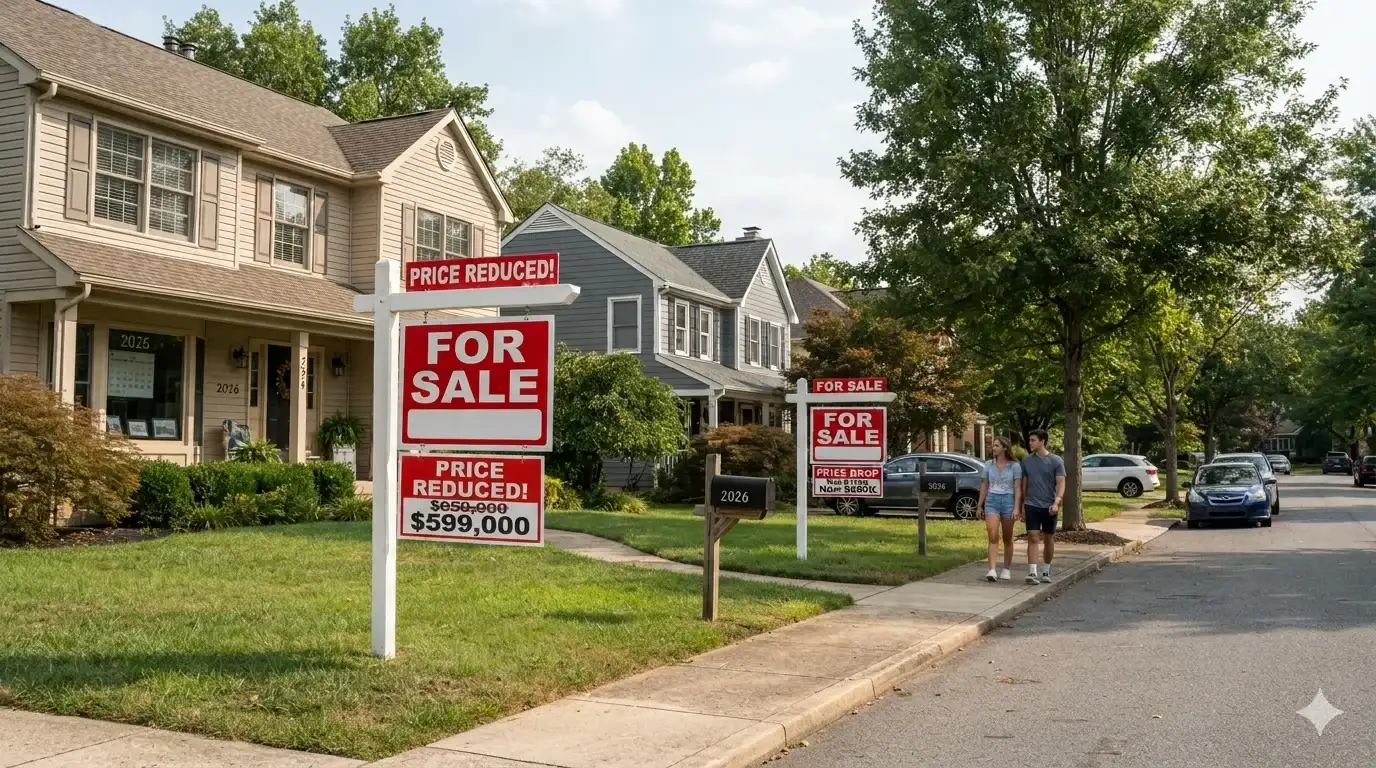
If you’ve been browsing homes in Charlotte and the surrounding areas, you’ve probably noticed something that was much less common a few years ago: price reductions are everywhere. So why are so many homes getting price cuts in 2026?
The biggest reason is simple: buyers have more choices, and sellers have to compete harder for their attention. More inventory, longer market times, increased buyer selectivity, and homes being initially priced too high are all contributing to more price reductions across the Charlotte area.
That does not necessarily mean home values are crashing. In many cases, a price reduction simply means a seller is adjusting the asking price to better reflect what today’s buyers are willing to pay.
For buyers and sellers in Charlotte, South Charlotte, Davidson, Cornelius, Huntersville, Mooresville, Denver, Concord, Kannapolis, Harrisburg and University City, understanding why these reductions are happening can help you make a much more informed real estate decision.
If you’re looking for local guidance, Odell Realty works with buyers and sellers throughout the Charlotte and Lake Norman area.
What Is Happening in the Charlotte Housing Market in 2026?
The Charlotte-area housing market has become more balanced compared with the highly competitive market many buyers experienced during the pandemic years.
According to Realtor.com, Charlotte had 11,263 active listings in August 2026, an increase of 15.5% compared with the previous year. The median list price was $429,000, down 2.5% year over year, while the median number of days on market increased to 61 days.
More homes for sale means buyers have more opportunities to compare properties. When buyers have several similar homes to choose from, sellers have to pay closer attention to pricing, condition, presentation and overall value.
That is one of the biggest reasons we’re seeing more price reductions.
1. Buyers Have More Choices
One of the simplest reasons for increased price cuts is that buyers have more homes to choose from.
When inventory is extremely limited, buyers may feel pressure to make an offer quickly because they don’t know when another suitable home will become available.
Today’s buyers often have the ability to slow down, compare multiple properties and negotiate.
Imagine you’re shopping for a home around $500,000 and find three similar properties in the same general area. One is listed at $525,000, another at $510,000 and another at $495,000.
The $525,000 home may struggle to attract attention unless it offers something that justifies the additional cost.
This is why sellers are having to think about their home in relation to the competition, not simply what they believe their home should be worth.
2. Some Sellers Are Still Pricing Homes Based on the Past
One of the most common mistakes we see in changing markets is relying too heavily on what a nearby home sold for several months or even a year ago.
A seller might say, “The house down the street sold for $550,000, so ours should be worth $550,000 too.”
But today’s buyers are looking at today’s competition.
A home’s value is influenced by recent comparable sales, current listings, condition, updates, location, lot characteristics, property type and buyer demand.
A home that was reasonably priced six months ago may need a different strategy today if the number of competing properties has increased.
At Odell Realty, one of the biggest conversations we have with sellers is the difference between the price a seller wants and the price the current market will actually support.
The better question is:
“At what price will today’s buyers believe this home represents a good value compared with their other options?“
3. Buyers Are Becoming More Selective
Today’s buyers are still buying homes, but many are being more careful about where they spend their money.
Buyers are paying close attention to things such as:
- Overall condition
- Recent renovations
- Kitchen and bathroom updates
- Roof and HVAC age
- Flooring and paint
- Outdoor spaces
- Lot size
- Location and commute
- Monthly payment
- Property taxes
- HOA costs
- Potential repair expenses
This means two homes with similar square footage and similar list prices can have completely different results.
For example, a move-in-ready home listed at $475,000 may attract more interest than a home listed at the same price that needs a new roof, flooring and significant cosmetic updates.
Today’s buyer isn’t necessarily looking for the cheapest home.
They’re looking for the best value.
4. A Price Reduction Does Not Automatically Mean a Home Is a Bad Investment
Seeing a “price reduced” notification online can make buyers wonder what is wrong with the property.
Sometimes there is a legitimate issue. But a price reduction doesn’t automatically mean the house has major problems.
A seller may reduce the price because:
- The home was initially overpriced
- Comparable homes are listed for less
- Buyer feedback indicated the price was too high
- The property has been on the market longer than expected
- New competition entered the market
- The seller wants to generate additional showings
- The seller’s circumstances have changed
- The seller wants to attract a new group of buyers
In other words, the reason behind the price reduction matters.
A buyer should look beyond the price-cut notification and evaluate the entire property.
5. Charlotte-Area Markets Are Not All the Same
One of the most important things for buyers and sellers to understand is that there isn’t one single “Charlotte real estate market.”
Market conditions can vary considerably between communities and even between neighborhoods.
Davidson, Cornelius and Huntersville
Buyers shopping in Davidson, Cornelius and Huntersville may encounter everything from established neighborhoods to newer construction and higher-end properties around the Lake Norman area.
That means buyers have plenty of factors to compare, including location, lot characteristics, updates, community amenities and proximity to major roads and employment centers.
Mooresville
Mooresville has also seen a significant number of homes experience price reductions.
An analysis of Canopy MLS data for sales from January 1 through June 16, 2026 found that approximately 45% of closed sales in Mooresville had experienced at least one price reduction before selling.
That statistic doesn’t mean that 45% of Mooresville homes are losing value.
It means that a substantial number of sellers had to adjust their asking price before finding the right buyer.
That’s an important distinction.
Concord and Kannapolis
Concord and Kannapolis offer a wide range of homes and price points, and buyers in these markets can often compare several properties with similar features.
That makes accurate pricing particularly important for sellers.
A home doesn’t have to be the cheapest property available, but it needs to make sense compared with the alternatives a buyer can purchase.
Denver, Harrisburg, University City and Charlotte
The same principle applies throughout Denver, Harrisburg, University City, Charlotte and South Charlotte.
A buyer considering a $450,000 home in one community isn’t necessarily comparing it to every other $450,000 home in the Charlotte region.
They’re comparing it to the homes that offer similar location, condition, size, features and overall value.
That is why local knowledge matters when determining the right price.
You can explore Charlotte-area neighborhoods and communities to learn more about the areas you’re considering.
What Do Price Cuts Mean for Buyers?
For buyers, increased price reductions can create opportunities that were much harder to find in a highly competitive market.
A buyer may have more room to negotiate on:
- Purchase price
- Seller-paid closing costs
- Repairs
- Concessions
- Home warranties
- Other terms of the transaction
However, buyers should not assume that every price-reduced home is automatically a bargain.
Before making an offer, look at:
- The original list price
- The current list price
- How long the home has been on the market
- Whether the price has been reduced more than once
- Recent comparable sales
- The condition of the property
- Similar homes currently for sale
- The seller’s circumstances when that information is available
A $20,000 price reduction doesn’t necessarily mean the home is worth $20,000 less than the original asking price.
It may simply mean the original price was too high.
Should You Offer Below the Asking Price on a Price-Reduced Home?
Sometimes, but there isn’t a universal percentage that buyers should use.
A common mistake is thinking:
“The seller already reduced the price, so I’ll offer another 10% below that.”
That may work in some situations, but it could also cause a buyer to lose a home that is already priced competitively.
Instead, the offer should be based on the home’s current market position.
If recent comparable homes have sold for less than the asking price, the property needs significant repairs, or the home has been sitting on the market for an extended period, there may be a stronger case for negotiating.
On the other hand, if the seller has already priced the home competitively and the property is receiving significant interest, a large discount may not make sense.
The goal is not simply to make the lowest offer. The goal is to make an offer that is supported by the market.
What Do Price Cuts Mean for Sellers?
For sellers, the increase in price reductions is a reminder that pricing strategy matters more than ever.
One strategy that can backfire is:
“Let’s list high and reduce the price later if we don’t get an offer.”
The problem is that an overpriced home can lose valuable attention during the first several weeks on the market.
Buyers may skip the property because they believe it is too expensive. Over time, the listing can accumulate days on market, and buyers may begin wondering why the home hasn’t sold.
Eventually, the seller may reduce the price, but now they’re trying to regain attention that could have been captured from the beginning.
That doesn’t mean sellers should underprice their homes.
The goal is to position the property correctly from the start.
What Should Sellers Do If Their Home Isn’t Getting Offers?
If a home isn’t generating offers, the answer isn’t always simply “drop the price.”
Sellers should first evaluate several factors.
Price
Is the home competitively priced compared with similar properties that buyers can purchase today?
Condition
Are there obvious repairs or maintenance issues that could be discouraging buyers?
Presentation
Do the photos, staging and online presentation accurately showcase the property?
Buyer Feedback
Are buyers and agents consistently mentioning the same concerns?
Competition
Have new homes entered the market that offer buyers a better value?
Marketing
Is the property receiving enough exposure to qualified buyers?
Sometimes the price needs to change.
Other times, improving the presentation, addressing an issue or changing the marketing strategy may make a meaningful difference.
The important thing is to identify the actual problem before making a decision.
Are Price Cuts a Sign That Charlotte Home Prices Are Crashing?
Not necessarily.
Price reductions and declining home values are two different things.
A seller can reduce a home’s asking price because the original list price was too high without the home’s underlying market value experiencing a dramatic decline.
For example, if a home is listed for $550,000 but comparable homes suggest buyers are willing to pay closer to $525,000, reducing the asking price to $525,000 is a pricing adjustment.
It doesn’t necessarily mean the home suddenly “lost” $25,000 in value.
This is why it’s important to look at actual comparable sales and current competition rather than focusing only on the number displayed next to “price reduced.”
What Should Charlotte Buyers and Sellers Watch for in 2026?
The biggest takeaway is that pricing and value matter more than they did when inventory was extremely limited.
Buyers should pay attention to:
- Price reductions
- Days on market
- Recent comparable sales
- New listings
- Seller concessions
- Property condition
- Local inventory
Sellers should pay attention to:
- Current competition
- Recent sales
- Showing activity
- Buyer feedback
- Days on market
- Online presentation
- Pricing relative to competing homes
The Charlotte-area market is large and diverse, so these factors can look very different from one neighborhood to another.
Frequently Asked Questions About Charlotte Home Price Reductions
Why are so many Charlotte homes getting price cuts in 2026?
The primary reasons are increased inventory, longer market times, increased buyer selectivity and homes being initially priced above what the current market supports.
Does a price reduction mean the seller is desperate?
Not necessarily. A seller may reduce the price simply because the home was initially overpriced or because market conditions have changed.
Is 2026 a good time to buy a home in Charlotte?
There isn’t one answer for every buyer, but increased inventory and more price reductions can provide buyers with more opportunities to compare homes and negotiate.
How much should I offer on a price-reduced home?
There is no universal percentage. A reasonable offer should be based on comparable sales, property condition, current competition, days on market and the seller’s circumstances.
Should sellers reduce their price if they aren’t getting offers?
A price reduction may be appropriate, but sellers should first evaluate the property’s pricing, condition, presentation, competition and buyer feedback.
Which Charlotte-area cities are seeing price reductions?
Price reductions are occurring throughout the Charlotte region, including Charlotte, South Charlotte, Davidson, Cornelius, Huntersville, Mooresville, Denver, Concord, Kannapolis, Harrisburg and University City. The frequency and size of reductions can vary considerably by neighborhood, property type and price range.
The Bottom Line for Charlotte Buyers and Sellers
The increase in price reductions across the Charlotte area is a sign that the market has become more competitive for sellers and more flexible for buyers.
For buyers, that can create opportunities to negotiate and find better value.
For sellers, it means pricing a home correctly from the beginning is more important than simply testing the highest possible asking price.
Whether you’re looking at homes in Charlotte, South Charlotte, Davidson, Cornelius, Huntersville, Mooresville, Denver, Concord, Kannapolis, Harrisburg or University City, the right strategy depends on the specific property and the market around it.
Thinking About Buying or Selling in the Charlotte Area?
A price reduction can tell you something about a home’s position in the market, but it doesn’t tell the whole story.
At Odell Realty, we can help you evaluate current listings, recent comparable sales, pricing and negotiation opportunities so you can make a confident decision based on today’s market.
Want to know what your home could realistically sell for in today’s market? Or want help finding homes where the numbers make sense? Contact Odell Realty today and let’s talk about your goals.
Want this explained for your exact situation?
Send a note below, or email garrett@odellrealty.com. A real person from our team answers.
Get in Touch